.webp)
Why Members and Parents Stop Renewing Memberships And How to Prevent It

Most service businesses think renewals happen at the end of the customer journey.
A reminder email goes out.
A renewal call gets scheduled.
Maybe a discount is offered to convince the customer to stay.
But the truth is, most customers decide whether they’re continuing long before that conversation ever happens. They decide through the everyday experience they have with your business.
It’s in the classes that they stop attending consistently. The progress they no longer feel excited about. The communication that slowly fades. The moments when your business becomes less important in their routine.
And this happens more often than most businesses realize.
In fitness, one longitudinal study found that new-member attendance dropped from an average of 7.48 visits in the first month to just 0.92 visits by month twelve. Only 22% of members were still actively attending after a year. Another industry report found that average annual member retention across fitness operators was only 66.4%.
The biggest takeaway? Customers rarely leave suddenly. They disengage gradually.
By the time a parent decides not to re-enroll their child, or a member cancels their subscription, the decision has usually been building quietly for weeks or even months.
The renewal date is simply the moment they finally act on it.
Why do customers slowly drift away from your business?
Customers move away from your business for different reasons. Let’s understand each of these one by one-
1. Thinking about retention as a sales problem-
Many service businesses treat renewals like a sales task. When a membership is about to expire or a program is ending, the focus suddenly shifts to retention. But by now, the customer has already spent months deciding how they truly feel about the business.
Customers don’t renew simply because they received a well-timed email. They renew because, throughout their journey, the experience consistently felt valuable. And that’s where many businesses get retention wrong.

The problem usually isn’t the final renewal conversation. The problem is everything that happened before it.
- Did customers feel engaged regularly?
- Did they see progress over time?
- Was booking and attending classes easy?
- Did communication feel personal and supportive?
- Did the experience become part of their routine and lifestyle?
These everyday interactions shape whether customers feel connected to a business or disconnected from it.
The CMO Survey found that businesses spend 19.6% more on customer acquisition than retention, while B2B service businesses specifically spend 17.3% more on acquisition efforts.
These experiences create an emotional connection that drives long-term loyalty.
2. Missing signs of disengagement by clients
Most customers don’t leave because of one bad experience. They leave because of a series of small disconnects that build over time.
At first, the changes are subtle.
- A parent who never misses a class suddenly starts cancelling frequently.
- A member who used to engage regularly becomes inactive.
- Customers stop exploring new programs or participating in events.
- Communication becomes slower and less responsive.
- Progress starts feeling unclear or stagnant.
Individually, these moments may not seem alarming. But together, they often signal something much bigger: the customer is slowly disengaging from your business.
Research in the fitness industry highlights how early this disengagement can begin. One study found that exercising at least four times a week for six consecutive weeks was the minimum pattern associated with long-term habit formation. This means customer retention is often decided much earlier than businesses assume, usually within the first six to twelve weeks of the customer journey, not during the renewal month.
This is why declining engagement should never be ignored. The businesses that retain customers successfully are usually the ones paying attention to these signals early and responding proactively.
3. Focusing too heavily on acquisition
Most activity and service businesses put enormous effort into acquiring new customers. They invest heavily in ads, promotions, social media campaigns, trial classes, referral offers, and lead generation strategies.
But once the customer joins, the energy shifts tremendously. They do not feel what they were promised, or at least what the potential experience seemed. Communication becomes less frequent. Engagement becomes reactive instead of proactive. Customers are expected to “figure things out” on their own unless there’s a problem.
This is especially true for service businesses because customers are not just paying for access; they are paying for outcomes, experiences, and progress.
The businesses with the strongest retention rates don’t stop nurturing customers after the first purchase. They continue building the relationship long after onboarding is complete.
4. Not focusing on visual progress
One of the strongest drivers of customer retention is simple: people stay when they can clearly see that they’re improving. In many activity-based businesses, the small wins matter just as much as the big ones.
- A child attending classes consistently for a month.
- A student moving up a skill level.
- A martial arts learner getting closer to their next belt.
- A swimmer becoming more confident in the water.
- A coaching client completing milestones or building better habits.

These moments create momentum. They give customers a sense that they or their children are moving forward, even if the transformation is gradual.
Remember, customers don’t just buy classes, memberships, or coaching sessions. They buy the feeling of growth.
4. Infrequent communication
Many service businesses unintentionally reduce communication to only operational updates. Customers hear from the business when a payment is due, a renewal is approaching, a class gets rescheduled, or there’s an issue that needs attention.
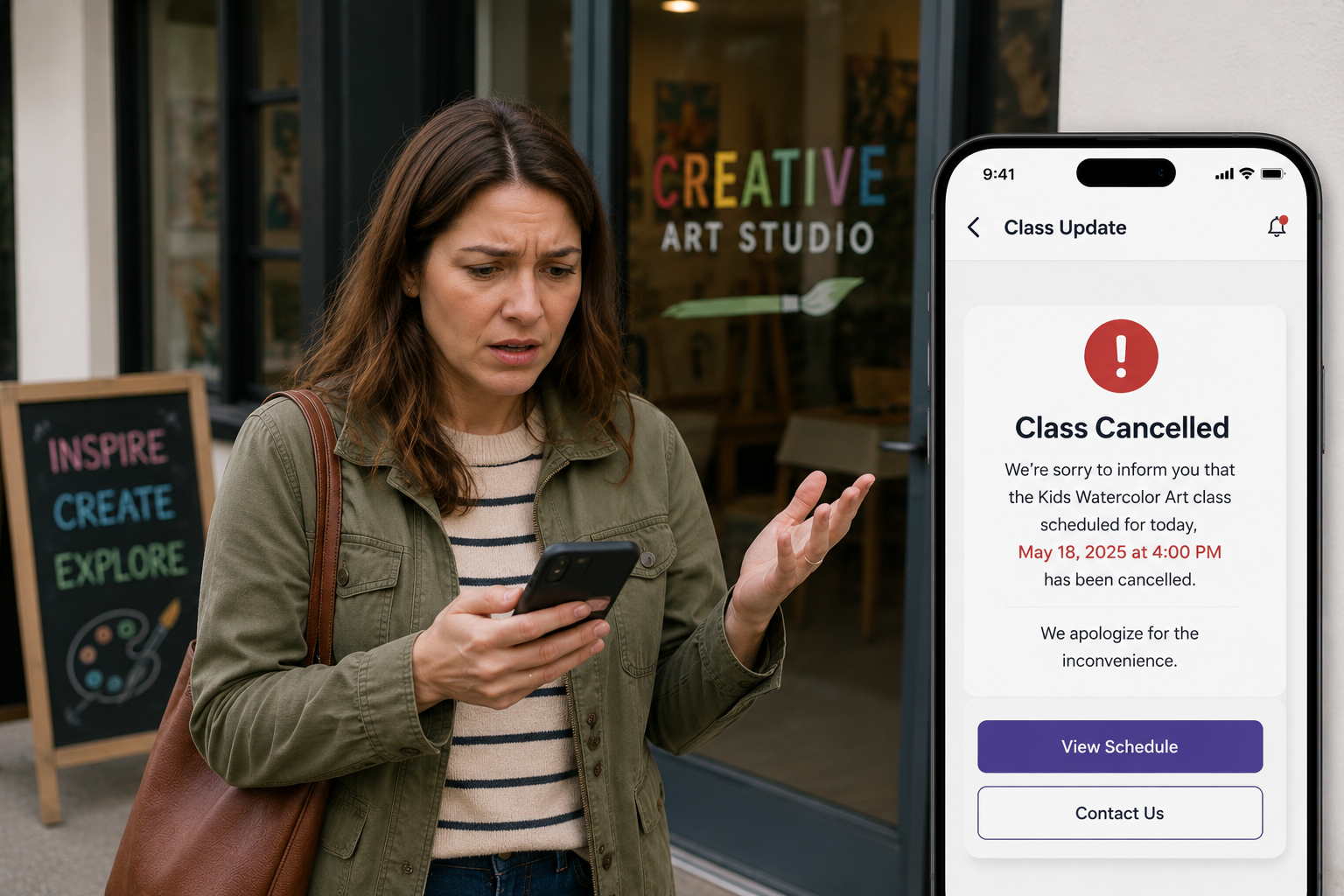
(sudden cancellation of class without prior notice)
But strong customer relationships are not built through transactional communication. They are built through consistent engagement that makes customers feel supported, involved, and valued throughout their journey.
Academic research on customer retention highlights an important difference between proactive and reactive retention strategies. Reactive retention focuses on trying to recover customers after they have already disengaged or decided to leave. Proactive retention, on the other hand, identifies early signs of dissatisfaction and addresses them before the customer relationship starts breaking down.

So how do businesses start proactive communication, strengthening trust, and reinforcing value consistently? You can do something as simple as:
- celebrating milestones,
- sharing progress updates,
- recommending the next suitable program,
- checking in after repeated absences,
- recognizing achievements,
- or asking for feedback
And when customers feel seen, supported, and connected regularly, they are far less likely to quietly drift away over time.
How can Omnify help?
Use this quick checklist to identify early signs of customer disengagement and strengthen renewals before they become a challenge. These simple but effective practices can help Omnify users improve retention, engagement, and long-term customer loyalty.
Conclusion:
Customer retention is rarely influenced by a single renewal email or follow-up call. It’s built through the everyday experiences customers have with your business, from consistent engagement and clear progress tracking to smooth scheduling, communication, and support.
With Omnify, service businesses can manage these experiences more effectively through automated reminders, attendance tracking, customer communication, memberships, and progress visibility, helping create stronger relationships that encourage customers to stay engaged for the long term.
Learn why customer renewals are decided long before renewal time and how businesses can improve retention through better customer experiences with Omnify.