.webp)
Beyond Google Maps: How Customers Will Discover Local Fitness Businesses in the AI Era
The new "near me" search
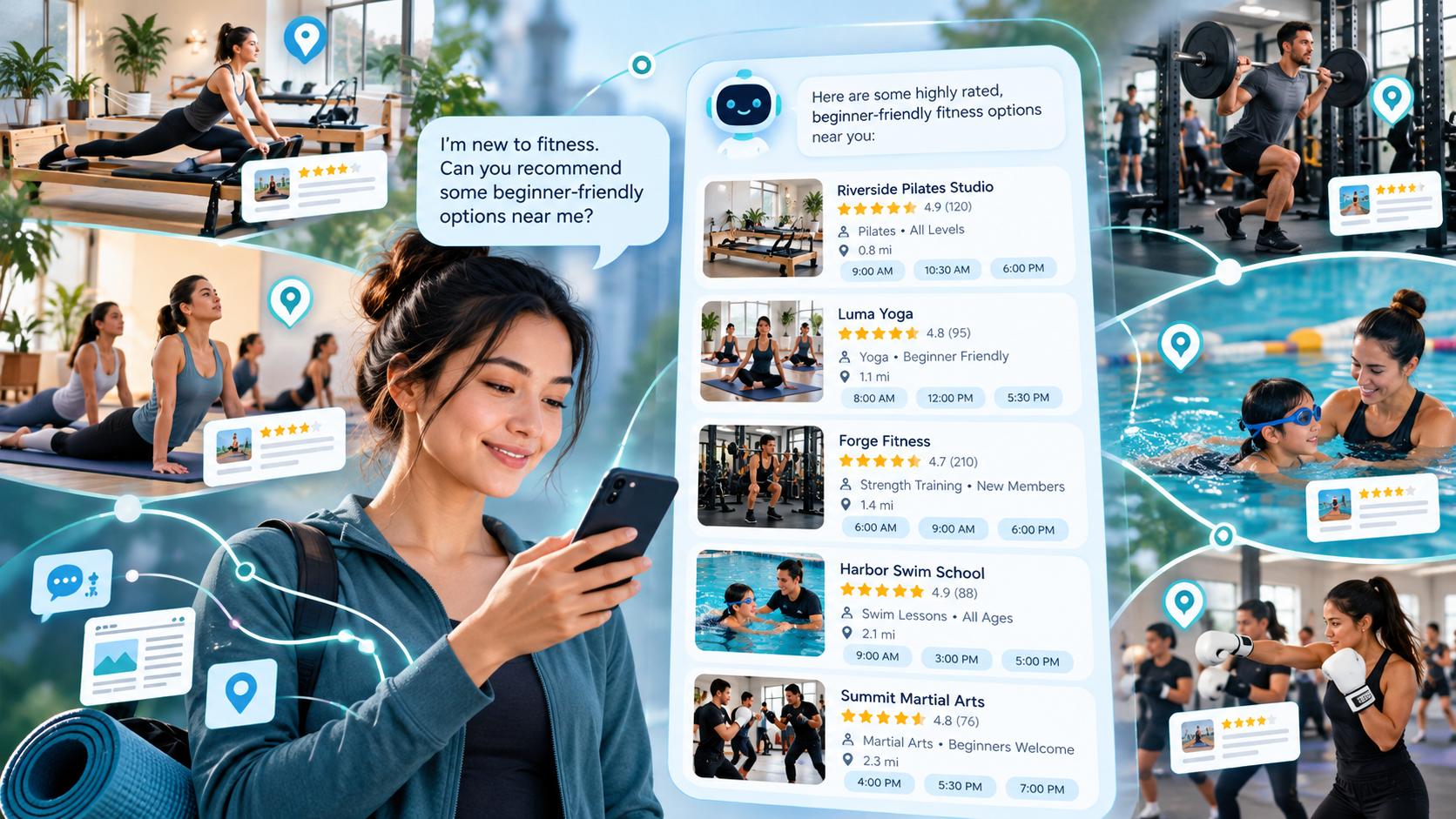
A new resident asks ChatGPT: "What's a good beginner-friendly reformer Pilates studio near me that has early morning classes?" Within seconds, the assistant names three studios, explains why each fits, and suggests booking a trial.
There's no map to scroll and no list of ten blue links. If your studio isn't one of those three names, that customer may never see you.
This is already happening at scale. BrightLocal's 2026 Local Consumer Review Survey of 1,002 US consumers found that 45% used AI tools such as ChatGPT for local business recommendations, up from 6% a year earlier. AI is now the third most popular source of local recommendations, behind only Google and Facebook.
For gyms, yoga and Pilates studios, swim schools, martial arts academies and sports clubs, discovery is spreading beyond Google Maps. This guide covers what decides who gets recommended, and how to test whether AI assistants name your business today.
Quick answer
To give your business a better chance of appearing:
- Maintain accurate listings: Update your business category, address, class hours, amenities, and booking details.
- Earn useful reviews: Encourage recent, genuine feedback that describes specific classes and customer experiences.
- Publish focused local pages: Explain your programs, prices, schedules, and suitability for different audiences.
- Build local recognition: Seek relevant mentions through partnerships, community events, and trusted publications.
- Check AI recommendations regularly: Test location-specific questions and address gaps you find.
How AI assistants answer local fitness questions
- Location influences recommendations: According to the OpenAI Help Center, ChatGPT search may estimate location using IP addresses. For example, it may interpret “restaurants near me” as a search for restaurants in San Francisco. The same location context can influence recommendations for nearby yoga studios.
- Specific customer needs shape results: Someone might search for “weekend swim lessons for toddlers” or “a boxing gym for complete beginners.” AI assistants then look for businesses that match these requirements.
- Multiple sources contribute to answers: Business listings, reviews, directories, forums, and local publications can all influence recommendations. Therefore, your website is important, but it is not the only source that matters.
- Recommendations often feature fewer businesses: Unlike Google Maps, which displays numerous options, AI assistants may suggest only a handful. This makes clearly communicating your specialties and services even more important.
Understanding these factors also explains why ranking well on Google Maps doesn't always guarantee an AI recommendation.
Why a good Google Maps ranking doesn't guarantee an AI recommendation
Ranking well on Google Maps is still valuable. It just isn't enough on its own anymore.
SOCi's 2026 Local Visibility Index analyzed more than 350,000 locations of multi-location brands. Those locations appeared in Google's local 3-pack 35.9% of the time on average, but ChatGPT recommended just 1.2% of them. The locations ChatGPT did recommend averaged 4.3 stars.
AI assistants are far more selective than maps, and they lean heavily on reputation. A studio can rank on the map and still be missing from the answer. Those figures come from established brands with many locations, which shows that size alone doesn't win AI recommendations.
The five building blocks of local AI visibility
1. Complete, accurate business listings everywhere customers look
Your Google Business Profile remains important, but customers also discover fitness businesses through other platforms. According to BrightLocal's 2026 consumer survey, Apple Maps usage for local recommendations increased from 14% to 27% in one year.
Therefore, maintaining accurate information across these platforms can improve your chances of appearing in relevant searches. Here's where to focus:
- Claim every major listing: Google Business Profile, Apple Business Connect, Bing Places, Facebook, Yelp, and any fitness-specific marketplaces or class booking apps you use.
- Choose precise categories: "Pilates studio" beats "gym." Add secondary categories that match what you offer, such as "personal trainer" or "swimming school."
- Fill in every field: Hours, class types, accessibility, parking, amenities, booking link, and photos of real classes. Empty fields give AI nothing to work with.
- Keep details consistent: Your name, address, phone number, and hours should match everywhere. Conflicting information makes AI less confident in recommending you.
Bonus: Omnify's local SEO checklist is a useful starting point for getting listings right.
2. Reviews that are recent, frequent, and specific
Reviews are the strongest trust signal for customers and AI alike. The 2026 consumer data shows how high the bar has risen:
- 74% of consumers only care about reviews written in the last three months.
- 47% won't use a business with fewer than 20 reviews.
- 31% will only use a business rated 4.5 stars or higher, up from 17% a year earlier.
- 89% expect owners to respond to reviews.
For fitness businesses, the content of reviews matters as much as the star rating. For example, a review stating, "Great for beginners, Priya's 7 AM reformer class is perfect before work," highlights specific benefits. These details can help AI assistants match your studio with relevant customer questions.
To encourage more detailed and useful reviews, follow these practices:
- Ask at the right moment: After a first class, a member's 30-day mark, a kid's swim level-up, or a personal best.
- Make it easy: Send a direct review link by SMS or email, or display a QR code at the front desk.
- Prompt for specifics: Ask members to mention the class, instructor, or result. Never script or incentivise positive reviews.
- Respond thoughtfully: Address questions and feedback with personal, helpful replies.
3. Local pages that answer real questions
When customers search for "the best kids' gymnastics classes in [your neighborhood]," AI assistants look for relevant information. A generic homepage may not provide enough details to match their needs.
Therefore, create dedicated pages that clearly explain your programs, locations, and services. Here's what to include:
- Create a page for each location and each core program: "Adult beginner swim lessons in Downtown Austin" is far more useful than "Our Programs."
- Answer the questions customers ask: Who it's for, class times, prices, trial offers, parking, what to bring, and how to book.
- Show proof: Instructor bios and qualifications, real photos, and short member stories with names (with permission).
- Make booking one click away: An online storefront with live schedules lets customers act on a recommendation immediately.
- Include relevant FAQs: Address common questions about each program using clear, customer-friendly language.
4. Mentions on other local websites
AI assistants also consider what other websites say about your business. Mentions from relevant local sources can strengthen your credibility and help more customers discover your studio.
Therefore, look for opportunities to build your presence beyond your own website. Here are some ways to do that:
- Get featured in local "best of" lists: Find city guides, neighborhood blogs, and lifestyle websites covering fitness businesses. Prioritize publications that AI assistants already cite.
- Participate in community groups: Answer relevant questions in local Facebook groups, Reddit communities, and parenting forums. Always disclose your business affiliation.
- Build local partnerships: Connect with physical therapists, running clubs, schools, and corporate wellness programs that may recommend your services.
- Join events and sponsorships: Participate in charity runs, school fairs, and community classes to earn mentions on local websites.
- Create useful video content: Share class previews, member experiences, and instructor tips on YouTube, Instagram, and TikTok.
5. Clear facts AI can repeat accurately
AI assistants sometimes repeat outdated hours, old prices, or discontinued classes. The fix is to publish clear, current facts in places AI reads.
- State facts plainly. "Drop-in classes cost $25. A 10-class pack costs $200. First class is free." Avoid vague phrases like "affordable pricing."
- Update everything at once. When schedules or prices change, update your website, listings, and booking pages on the same day.
- Use structured data on your website, such as local business schema, so search engines and AI tools can read your details reliably.
How to test whether AI assistants recommend your business
You can't improve what you don't measure. Here's a simple process any studio owner can run.
Step 1: Write the questions your customers ask
Aim for 15 to 25 questions across these types:
This table shows a mix of question types to track. Discovery questions tell you if you're visible; practical questions tell you if AI has your facts right.
Step 2: Ask several AI assistants
Run each question in ChatGPT, Gemini, Google AI Mode, and Perplexity. Use a fresh chat each time. Include the neighborhood or city in the question, since results can change from one area to the next.
Step 3: Record what you find
For each answer, note whether you're named, where you appear, which competitors are named, what sources are cited, and whether the facts about you are correct. Repeat each question a few times, because AI answers vary from one run to the next.
Step 4: Track it over time
Manual checks work for a small set of questions. However, tracking multiple assistants and locations quickly becomes time-consuming.
MentionBird lets you monitor chosen prompts by market, compare competitor visibility, and identify where your business is missing from relevant answers. It also highlights cited sources and suggests changes that may help close those gaps.
For an initial check, its free AI Visibility Report can provide a good starting view of your brand’s presence in ChatGPT.
Step 5: Fix gaps in order
Start with the quickest wins: wrong facts and incomplete listings. Then build reviews, then local pages, then third-party mentions. Re-test monthly to see what moved.
Running more than one location?
Multi-location gyms, franchises and sports clubs face a harder version of this problem. AI answers are local, so a strong location in one neighborhood does nothing for a weak one across town.
- Treat every location as its own business online: Each needs its own listing, its own page, its own reviews, and its own local mentions. A single "Locations" page with five addresses won't be matched to neighborhood questions.
- Expect different results in each area: The same question can produce different recommendations in nearby suburbs. Your flagship may be named while newer sites are invisible.
- Track questions per location, not per brand: MentionBird’s prompt tracking supports country-targeted tracking and prompt organization, helping teams examine performance across markets. Though for neighborhood-level comparisons, confirm the available location targeting first.
- Keep facts in sync across sites. Different hours, prices, or class names at each location are a common source of wrong AI answers. Running schedules and bookings from one system, such as Omnify's multi-location scheduling, makes it easier to keep every listing and page accurate.
- Share what works. When one location starts getting recommended, copy what changed (reviews, page content, local partnerships) to the others.
A 30-day plan for local fitness businesses
This plan starts with the fastest fixes and ends with the slower work of earning third-party mentions, which takes the longest to show up in AI answers. Multi-location businesses should run it for their weakest location first.
What should I fix first if AI doesn't recommend my business?
Start with accuracy. Make sure your hours, prices, address, and categories are correct on every listing and on your website. Then focus on recent reviews, local pages for each program and location, and mentions on local websites.

AI assistants now recommend local gyms and studios. Learn how listings, reviews, local pages and mentions decide who gets named, and how to test it.