.webp)
How IoT Is Transforming Fitness and Wellness Facilities: From Smart Access to Occupancy Tracking
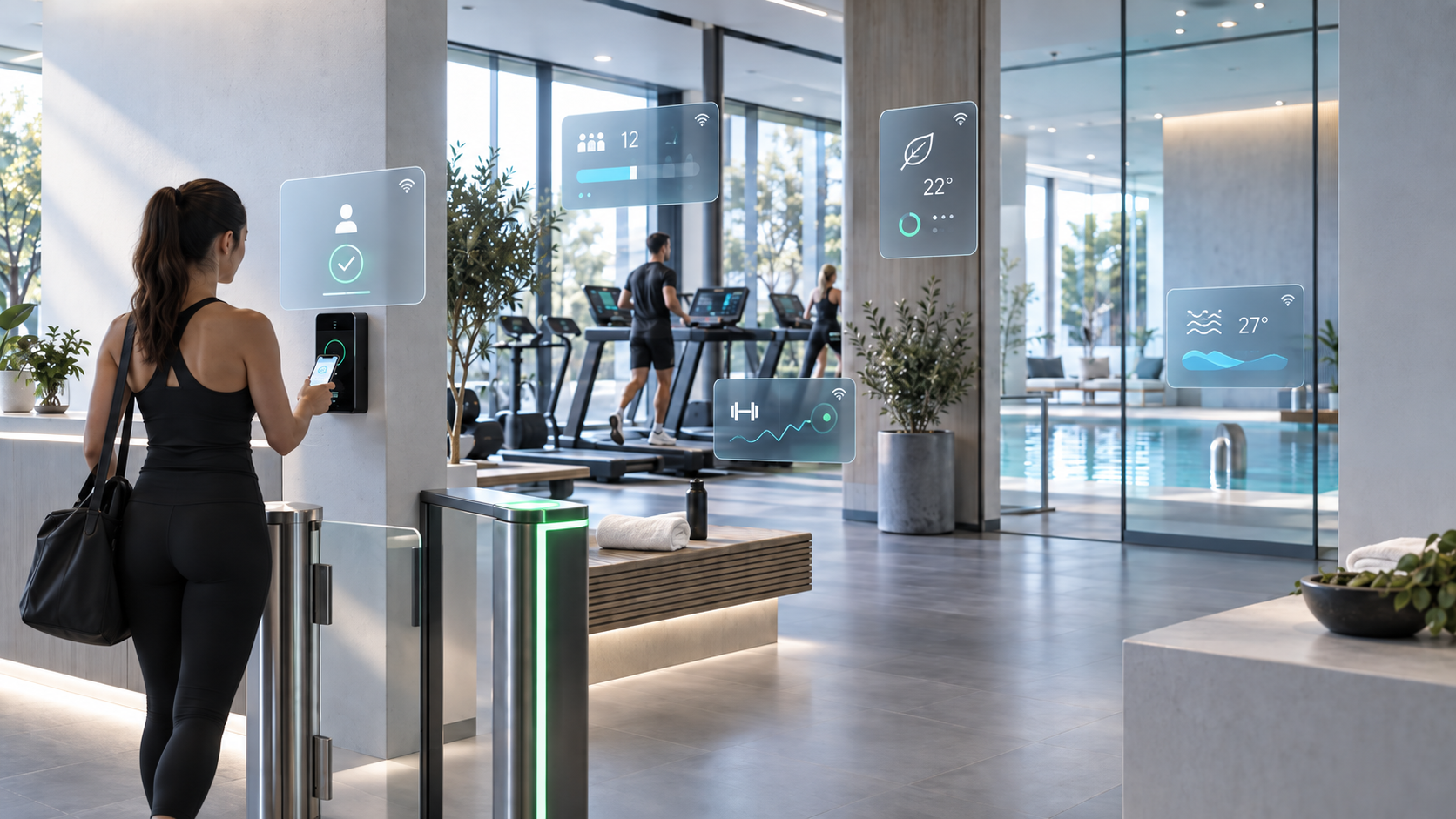
Running a fitness or wellness facility means keeping dozens of moving parts in sync: class schedules, member check-ins, equipment upkeep, staffing, and the comfort of everyone walking through the door. Booking and scheduling software has already automated much of the front office. The next wave of efficiency is coming from the physical space itself sensors, smart locks, and connected equipment that feed real-time data into the systems facility owners already use every day.
Here is how the Internet of Things (IoT) is quietly reshaping gyms, studios, pools, and wellness centers and what it means for owners and operators.
Smart access control tied directly to bookings
Keyless entry is one of the most practical IoT upgrades a facility can make. Smart locks and access readers connect to your booking system, so a confirmed reservation automatically becomes an access credential a QR code, a mobile pass, or a PIN valid only for the booked time slot.
The benefits compound quickly. Early-morning and late-night hours no longer require front-desk staff. No-shows are logged automatically because the door "knows" who actually arrived. And for multi-location businesses, access rules update centrally: a member's plan change at one site applies everywhere within minutes.
Real-time occupancy tracking
Overcrowded studios frustrate members; empty ones waste money. Occupancy sensors from simple door counters to ceiling-mounted people-tracking devices give operators a live picture of how space is actually used.
That data answers questions schedules alone can't: Which time slots are consistently under capacity? Do members leave when the weight area exceeds a certain headcount? Should the 6 p.m. yoga class move to the larger room? Some facilities publish live occupancy on their booking page, letting members pick quieter hours a feature that became popular during the pandemic and stuck around because members simply like it.
Connected equipment and predictive maintenance
Modern cardio machines, pool pumps, and HVAC units increasingly ship with built-in connectivity. Instead of waiting for a treadmill to break down mid-class, connected equipment reports usage hours, motor temperature, and error codes as they happen.
For operators, this shifts maintenance from reactive to predictive. You schedule service when the data says a part is wearing out not after a member files a complaint. Equipment downtime drops, repair costs shrink, and the busiest machines get attention first because you can finally see which ones those are.
Environmental monitoring for comfort and safety
Air quality, humidity, and temperature directly affect how a workout feels and, in pools and spas, water chemistry is a safety and compliance issue. IoT environmental sensors monitor these conditions continuously and alert staff the moment a reading drifts out of range.
Pool operators are among the biggest winners here. Automated monitoring of chlorine levels, pH, and water temperature reduces manual testing rounds, creates an audit trail for health inspections, and catches problems hours before they would be noticed by hand. In group fitness rooms, CO2 sensors can trigger ventilation before the air gets stale, keeping class quality consistent even at full capacity.
What implementation actually looks like
The good news: you don't need to rip out existing systems to get started. Most facilities begin with one high-impact use case usually smart access or pool monitoring and expand from there. Off-the-shelf hardware covers many scenarios, but connecting devices to your booking platform, member database, and dashboards typically requires some integration work. Facilities with specific requirements, such as custom sensors or multi-site data pipelines, often bring in a dedicated engineering team at this stage Yalantis IoT developers can take on hardware, firmware, and software as one connected system, so the technology fits their operations rather than forcing operations to fit the hardware.
A sensible rollout usually follows three steps: pick a single measurable problem (say, unstaffed off-peak access), pilot it at one location for a couple of months, then scale what works. Because IoT systems generate data from day one, you'll know quickly whether the investment is paying off.
The bottom line
IoT won't replace great instructors or a welcoming front desk but it removes the operational friction around them. Facilities that connect their physical space to their scheduling and management software gain lower staffing costs for off-peak hours, fewer equipment surprises, safer pools and cleaner air, and a member experience that feels effortless. As hardware prices continue to fall and integrations get simpler, the question for facility owners is shifting from "should we adopt IoT?" to "which problem do we solve with it first?
.png)
Discover how smart access control, occupancy tracking, and connected equipment help gyms, studios, and pools cut costs and improve member experience.